Member modeling
A practical framework for GFRP-RC members that captures reinforcement response, concrete behavior, joint distortion, and strain penetration. Published in Engineering Structures in 2026.
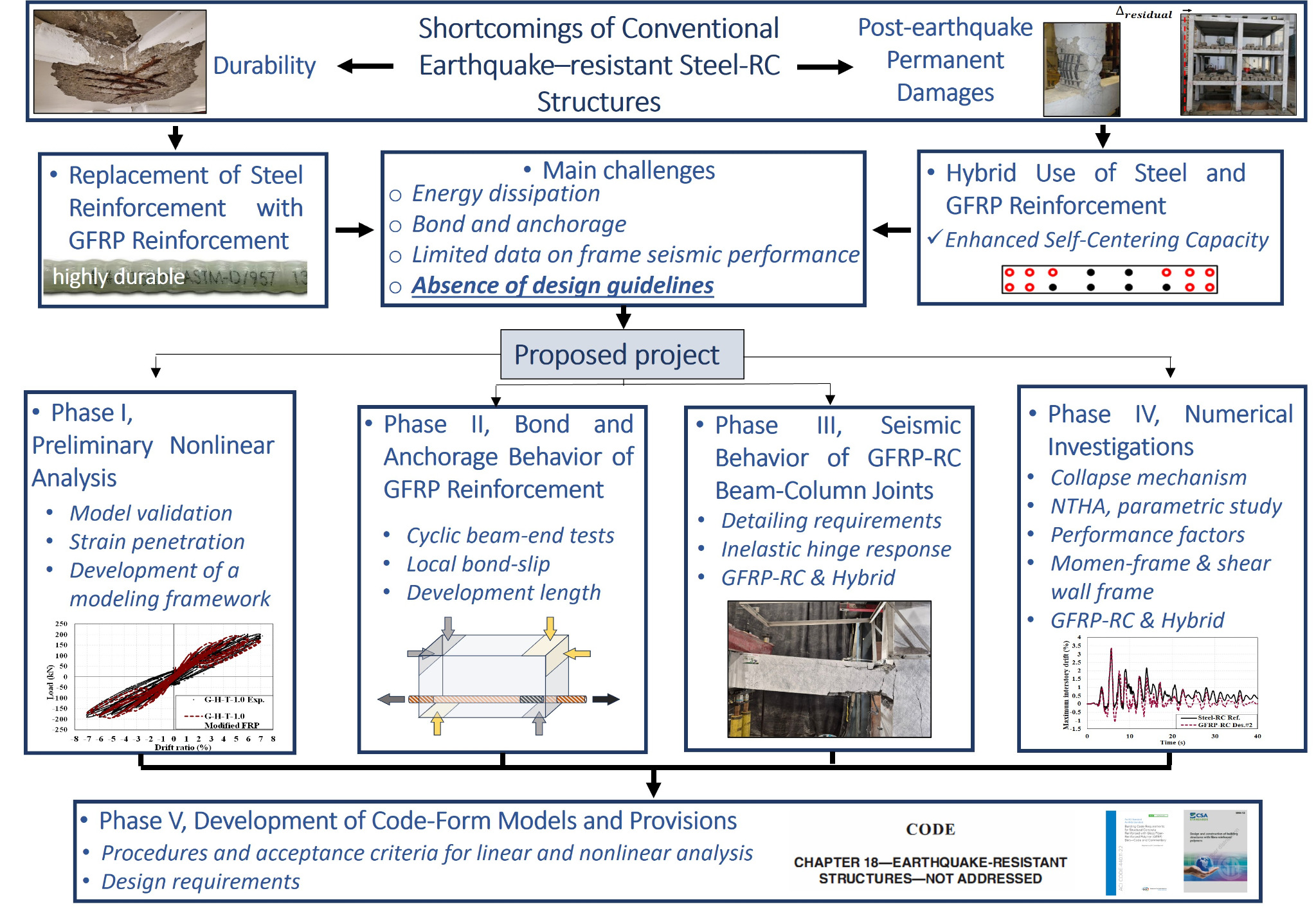
An extensive ongoing research program connecting material behavior, structural experiments, system-level analysis, and future design provisions.
McGill University · Ongoing program
Yi Shao, PI
Yazhou (Tim) Xie, Co-PI
Seyed Mohammad Hosseini, Co-PI
Gregory G. Deierlein ↗
Stanford University
Progress summarized from the August–September 2026 project report.
A validated OpenSees modeling framework, including strain penetration, followed by preliminary nonlinear frame evaluation and design insights.
Beam-end experiments, test-setup development, and analytical investigation of GFRP-to-concrete bond under reversed cyclic loading.
Two experimental series covering 12 connections, including GFRP and hybrid reinforcement configurations. Extended numerical and parametric work continues.
Moment-frame and shear-wall modeling, nonlinear time-history analysis, parametric studies, incremental dynamic analysis, and fragility assessment.
Development-length models, design and detailing provisions, seismic performance factors, and procedures and acceptance criteria for structural analysis.
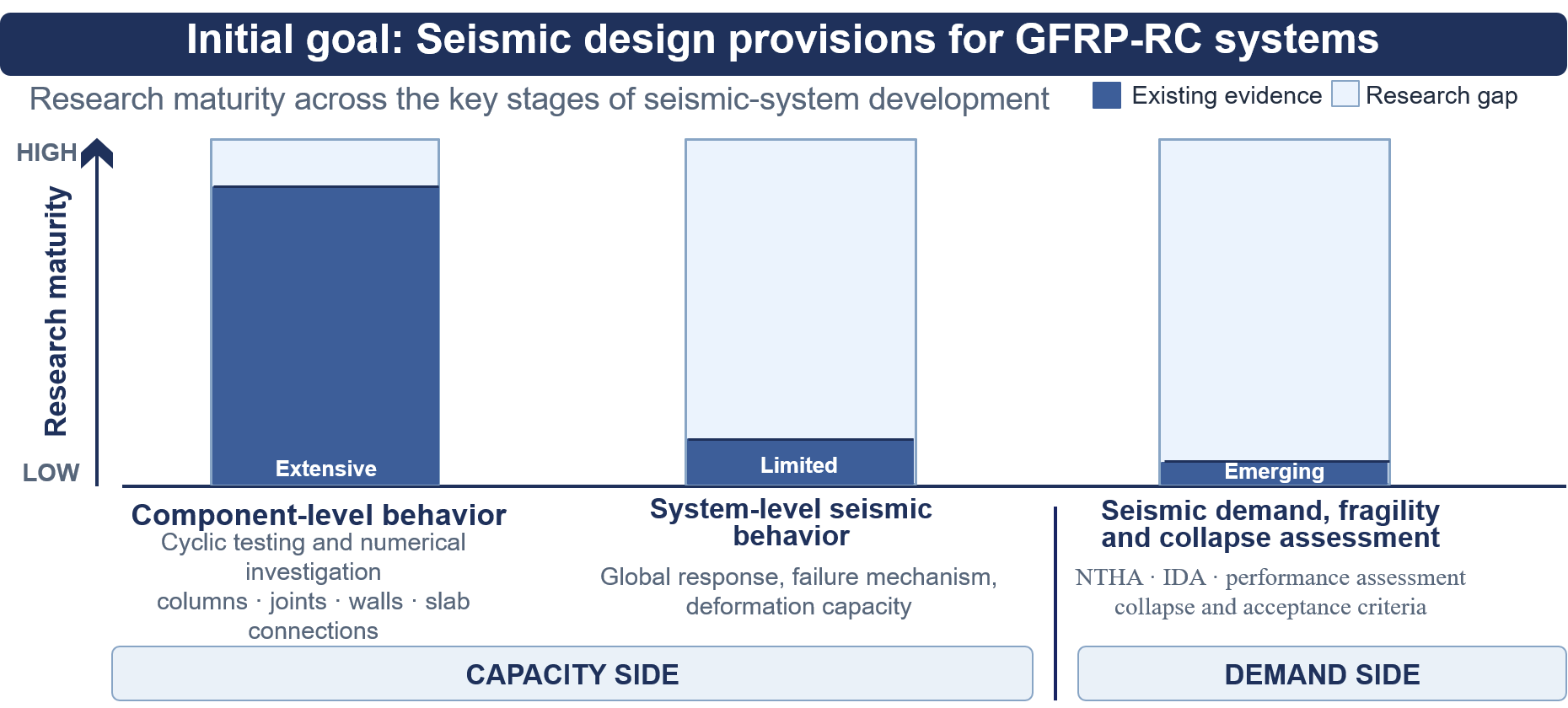
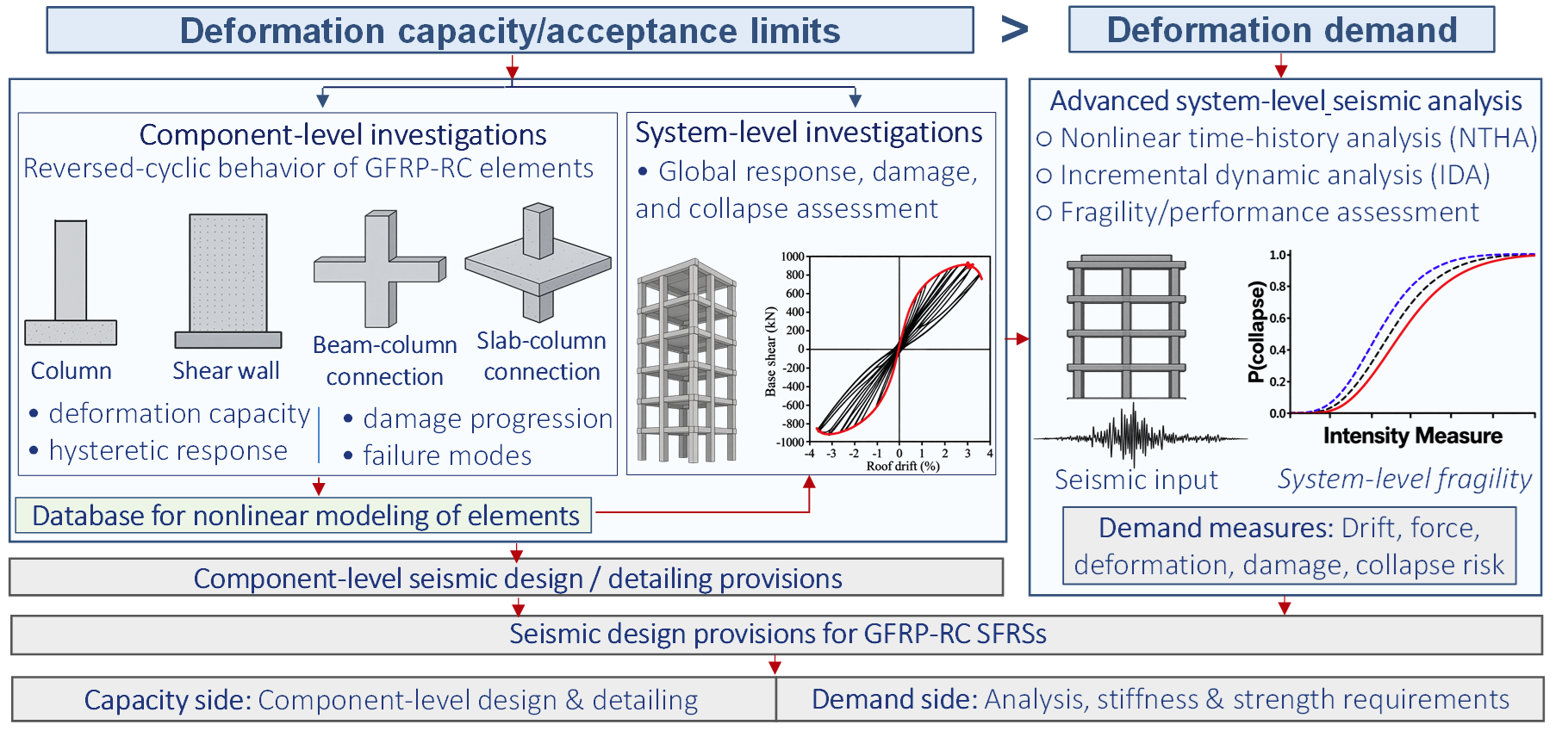
Component tests alone cannot establish how complete GFRP-RC systems will perform during earthquakes. This program addresses the missing connection between member behavior, system response, seismic demands, and reliable design criteria. Its findings are intended to inform future design standards for GFRP-reinforced seismic force-resisting systems.
A practical framework for GFRP-RC members that captures reinforcement response, concrete behavior, joint distortion, and strain penetration. Published in Engineering Structures in 2026.
Completed beam-end experiments and analytical work examining cyclic GFRP bond behavior and its implications for anchorage and development length.
Completed connection tests investigating confinement, reinforcement ratio, hybrid GFRP–steel and GFRP–stainless-steel reinforcement, and initial pulse loading.
Comparative frame analyses examining GFRP and steel reinforcement, drift demands, residual deformation, failure progression, and collapse behavior.
Model validation and parametric studies linking wall properties to response measures, limit states, and seismic fragility.
Ongoing translation of research evidence into design and detailing models, performance factors, and analysis acceptance criteria.
Hosseini, S. M., Chalabi, R., Xie, Y., and Shao, Y.
Engineering Structures, 367, 123558
Hosseini, S. M., Xie, Y., and Shao, Y.
Bulletin of Earthquake Engineering
More papers from this project are expected in the near future.
Research collaboration, structural design, and advanced materials.